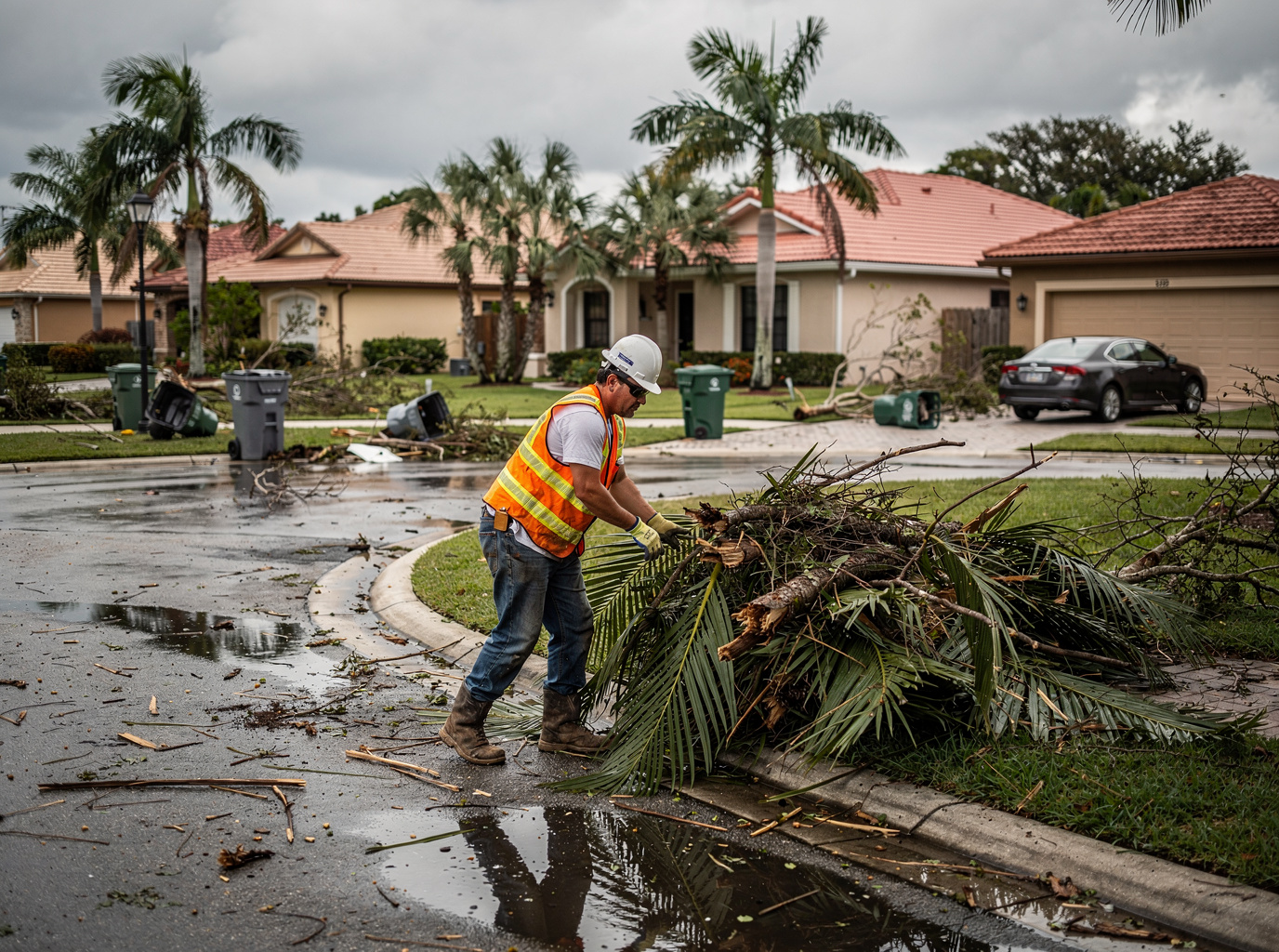
Why Pembroke Pines Homeowners Choose Us for Storm Damage Cleanup
Pembroke Pines homeowners choose this process because cleanup starts with documentation as found and removal before drying. Before anything is moved, lifted or thrown out, the damage is photographed as it was found, so the homeowner has a dated account of every affected room. That record is what a homeowner's insurance file needs. How an insurer treats any claim is the insurer's decision, and we make no promise about coverage or outcome.
Documentation comes first for a practical reason. Soaked drywall, carpet and furniture change within hours, and once they are pulled out, the evidence of where the water sat is gone. We photograph the water line on the walls, the standing water on the floor, the damaged contents and the path the water appears to have taken, then write those observations down by room and date.
Removal comes before drying. Wet material left in place keeps the structure wet, so standing water is pumped or extracted first. Saturated materials that cannot be dried are then taken out, starting with the most contaminated. Drying begins only once the space is clear enough for air to move across the surfaces that remain.
Finding the entry point is part of the cleanup, not an afterthought. A storm cleanup that dries the floor but leaves a failed roof detail or window seal open will be repeated with the next rain. The entry point is traced as the work proceeds, and the homeowner receives the finding in writing.
Before any further work begins, you receive a written scope that lists the rooms, the materials affected, the removal and drying steps, and the questions still open about the entry point. Further work follows that scope, so you always know what is being done to your Pembroke Pines home and why.
Why Storm Water in a Pembroke Pines Home Should Not Sit
Storm water should not sit in a Pembroke Pines home because it carries soil, debris and contaminants indoors, and every hour it stays in contact with building materials makes the cleanup harder. Pembroke Pines has 176,714 residents living in 64,875 households, and 69.6 percent of its housing units are owner-occupied.
Soaked drywall, insulation and flooring deteriorate once they stay wet. Drywall loses its strength, insulation holds water against the wall cavity, and wet flooring can cup, lift and trap moisture underneath. Those soaked materials deteriorate and become a mold risk.
The entry point is the other reason not to wait. If the water came through a roof detail, a window seal or a wall penetration, it will return with the next heavy rain unless that route is found and sealed or scheduled for repair.
Local exposure is documented in the flood maps. The Federal Emergency Management Agency's new Flood Insurance Rate Maps for Broward County became effective on July 31, 2024. Under those maps, high-risk Special Flood Hazard Areas are labelled A, AE, AH or VE, while low- and moderate-risk areas appear as X, 0.2 PCT or shaded X. The City of Pembroke Pines notes that updated base flood elevations apply to new construction and substantial improvements, which makes the current map worth checking before any rebuild. The April 2023 flood that hit Fort Lauderdale showed how fast non-hurricane rain can flood Broward homes, and a dry week does not mean a dry house.
Proof: How Storm Cleanup Is Scoped and Verified
Storm cleanup is verified by readings and records, not by how dry a floor looks. Each step below leaves a record the homeowner can keep.
- Safety first. Electrical power to affected areas is assessed before work starts, and contaminated water is handled with protective equipment and precautions for everyone in the home.
- Photos as found. The condition of each room is photographed before anything is moved.
- Standing water removed. Pump-out and extraction clear the water so the structure can be assessed properly.
- Entry point traced. The likely source is recorded as roof detail, window or door seal, wall penetration or plumbing, as far as the evidence shows.
- Moisture readings. Readings are taken across walls, floors, subfloors and baseboards, not only the visible wet area.
- Drying verified. Drying continues until readings are checked against the earlier baseline, and the final numbers are recorded.
- Removed materials documented. Every item taken out is listed by room and reason.
The Scenario Most Pembroke Pines Storm Pages Skip: The House That Floods From the Roof Down, Not the Yard In
The entry point has to be identified before cleanup can hold, and leak detection separates the roof, window or door seal, and slab or plumbing routes. After a storm, most homeowners assume the yard flooded and the water rose into the house from the ground. Sometimes that is correct. In other cases, water entered through a failed roof detail or a window seal, ran down inside the wall, and only later appeared as a stain or a soft floor far from the source.
Leak detection is what separates these routes. Roof-entry water typically shows highest in ceilings and upper wall cavities, often in a pattern that runs down a single wall. Window and door seal leaks usually stain the sill, the trim and the wall directly below the opening. Slab and plumbing sources show moisture low in the structure, sometimes with no sign of rain at all, so they are read against the drying pattern rather than against the weather. In every case the moisture pattern is traced back toward its likely source and checked against what the homeowner saw during the storm.
The order of the fix matters. The entry point is documented and then sealed, or scheduled for repair by the appropriate trade, before the wall is closed up. Drying a wall that keeps taking in water wastes time and leaves the structure wet. Removal and drying follow once the route is stopped or a repair date is set.
Documentation also helps separate storm damage from an older, slow leak. A stain with dried, layered edges and rot at the bottom of a wall cavity points to a longer history than a fresh tide line on the same wall. Findings, photos and readings are written down with dates, so the homeowner has a factual record of what was present when the work began. This record does not decide any insurance question and does not promise any outcome. It keeps the facts in one place for the homeowner's own files.
Storm Damage Cleanup in Pembroke Pines, Up Close
Water Removal After a Storm
Water removal after a storm means pumping or extracting standing water before anything else happens. Rain that pushes into a Pembroke Pines home can leave water across floors, under furniture and inside wall bases, and every hour it stands adds to the soaking of the materials around it. Removal follows an order. Water that carries soil or other contaminants is handled first with protective equipment, and porous materials that have taken contaminated water are removed rather than dried in place. Floors are made dryable by clearing surface water, lifting or removing materials that will not dry, and opening the space so air can move. When the work is finished, the floor and subfloor are checked for remaining standing water, including low spots and the areas under cabinets, and that check is recorded in the written scope, and the City Engineering Division can confirm the property's flood zone.
Water Leak Detection: Finding the Entry Point
Water leak detection answers the question of where the water came in. After a storm, the entry point can be a roof detail, a window or door seal, a wall penetration such as a vent or pipe sleeve, or a plumbing line. Each source leaves a different pattern. Roof and window water tends to run down inside walls and appear high or along the trim. Penetration water follows the penetration. Plumbing water often shows low in the structure and can appear without any rain at the surface. Moisture readings are taken across walls and floors, and the pattern is read back to the most likely source. The finding is documented with photos, readings and a clear note of what is confirmed and what is still open, because a repair trade needs a precise location to work from. In owner-occupied Pembroke Pines homes, that finding guides the repair.
Storm-Damaged Materials: What Comes Out, What Dries
Storm-damaged materials are assessed one by one, because a material's porosity and the length of its soak decide whether it can be saved. Drywall that has taken contaminated water is usually removed and cut back to a clean line above the water mark, so the wall cavity can be dried and checked. Insulation that has soaked through is removed, since it holds water and cannot be dried to a reliable condition. Flooring is judged by type and soak time. Solid surfaces that can be cleaned and dried may stay, while laminate, carpet pad and soaked underlayment are usually removed. Baseboards and trim that are swollen or separating are taken off so the wall base can be opened and dried. Salvageable structure, such as framing, sound subfloor and hard surfaces, is dried, then verified with readings. In owner-occupied Pembroke Pines homes, each decision is written into the scope with its reason.
Drying and Mold Prevention After Storm Cleanup
Drying and mold prevention come after removal, and both are measured rather than assumed. Structural drying runs air movement and dehumidification through the cleared space. Readings are taken across the framing, subfloor and wall cavities before close-out and compared against the earlier baseline. The structure is treated as dry only when the readings show it. A storm soak is also a reason to check for mold, because growth can start in damp material that was never removed. If visible growth appears, or a musty smell lingers after drying, the next step is a mold service, and mold remediation in Pembroke Pines is covered on the mold remediation page. Flood-zone awareness matters for the next event too. Check the property's current FEMA flood zone before any rebuild, because the July 31, 2024 maps set the flood zone and the base flood elevations that apply to new construction and substantial improvements.
Storm Damage Cleanup Questions Pembroke Pines Homeowners Ask
What should I do first after storm water gets into my house?
Start with safety. Keep people and pets out of standing water, and do not run electrical equipment in wet areas. Photograph each room as it was found, including the water lines, the standing water and the damaged contents, before anything is thrown out. Keep damaged material until it has been documented, then call for cleanup so the removal can follow a clear record.
How do I know if my Pembroke Pines home is in a flood zone?
FEMA's Flood Insurance Rate Maps for Broward County took effect on July 31, 2024, and insurers use the finalized maps for flood insurance purposes. High-risk Special Flood Hazard Areas are labelled A, AE, AH or VE, while low- and moderate-risk areas are labelled X, 0.2 PCT or shaded X. To check a Pembroke Pines address, contact the City's Engineering Division, which can state the property's flood zone and whether an Elevation Certificate is on file.
Can you find where the water came in, or only clean it up?
Finding the entry point is part of this storm damage service, not a separate job. The process traces the moisture pattern, takes readings across walls and floors, and records the most likely source as a roof detail, a window or door seal, a wall penetration or plumbing. That finding is written down, so the repair can be scheduled with the right trade.
Will insurance cover storm cleanup?
That decision belongs to your insurer, and we do not promise coverage or any outcome. What we provide is documentation kept for your own records: photos as found, moisture readings and a written scope. The City of Pembroke Pines notes that standard homeowner's policies do not generally cover flood damage, so check your policy wording for flood coverage and discuss the details with your insurer.
How much does storm damage cleanup cost?
Cost depends on the factors that shape the work: how much standing water there is, how many rooms and materials are affected, whether contaminated water is involved, how long the structure needs to dry, and how easily the work can be accessed. Each of these factors is listed in the written scope for your specific home.
What is storm damage restoration?
Storm damage restoration is the full sequence that follows storm water entering a home: documenting the damage as found, removing standing water, finding the entry point, and drying and scoping the repairs needed before the structure is closed back up.
What is storm cleanup?
Storm cleanup is the cleanup part of that sequence: documenting the damage as it was found, removing standing water and damaged material, and drying the structure. Each step is recorded, so the homeowner has a clear account of what was done and why.
If storm water has come into your Pembroke Pines home, call (954) 481-0645 to talk through what has been found and what should happen first. Contact details, including the business address at 13160 NW 18th Ct, Pembroke Pines, FL 33028, are on the contact page.