Why Pembroke Pines Homeowners Choose Us for Mold Remediation
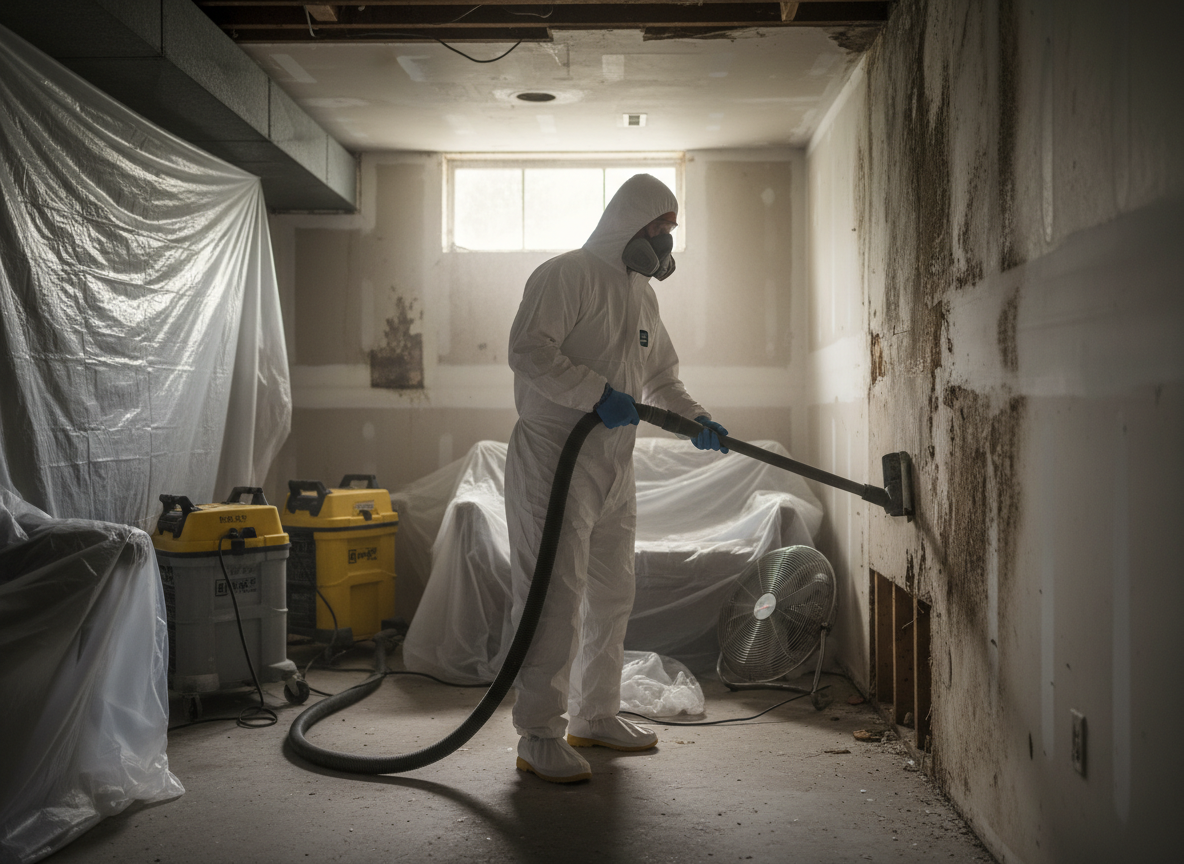
Our mold remediation work in Pembroke Pines follows a containment-first sequence. Before any material comes out, the affected area is sealed off so that spores and debris stay inside the work zone instead of drifting into bedrooms, kitchens or the air handler. The source of moisture is identified before the job is treated as finished, because removing growth from a wall that is still wet only restarts the cycle.
Every job starts with a written scope. Before work begins, the homeowner receives a description of the affected materials, the containment plan, the removal boundaries and the verification steps that will close the job. Changes to that scope are written down as they are agreed. When the work is complete, the homeowner receives documentation for their own records: photographs of the area, moisture readings and the written scope as it was carried out.
Homeowners should also know how Florida regulates this trade. Florida licenses mold remediators through the Department of Business and Professional Regulation (DBPR), and any homeowner can look up a company's license status there before hiring anyone for mold work. We encourage you to check every company you consider, including this one. Nothing on this page states or implies that this business holds a mold license, certification or insurance. Ask any company for its license information in writing, and verify it yourself with DBPR.
Why Mold in a Pembroke Pines Home Should Not Wait
Mold growth continues for as long as the moisture that feeds it continues. A slow leak behind a vanity, condensate dripping from an air handler or a damp wall near a shower will keep supplying the conditions mold needs, so the growth you can see is rarely the whole story. Waiting does not pause the problem. It gives the moisture more time to soak into the materials around the growth.
Porous materials are the reason delay makes the job bigger. Drywall paper, insulation, carpet pad and wood framing can hold growth beneath the surface. When colonised material stays in place, it keeps releasing spores into the room and cannot be cleaned to a standard that makes it safe to keep. A delayed job can turn a small section of wall that could have been cut out cleanly into a longer run of drywall, baseboard and flooring that has to come out and be rebuilt.
South Florida's climate makes this worse. Pembroke Pines is hot and humid for much of the year, and closed rooms do not dry themselves out. A guest room with the door shut, a linen closet on an exterior wall or a bathroom with a fan that is rarely used can hold moisture long after the visible water is gone. Air conditioning helps, but it does not replace a drying plan when the cause of the wetness is still present.
The practical reason to act is that a moisture problem left alone takes more work to correct and makes the rebuild harder to plan. Acting early keeps the scope focused on the affected area and on the source.
Proof: How Mold Remediation Is Scoped and Verified
Mold remediation is judged by what was done and what was measured, not by how clean the room looks. The process runs in a fixed order, and each step leaves a record.
The first step is inspection of the affected area and its moisture source. The inspector records where growth is visible, which materials are affected and where moisture readings are elevated. The source of the water is identified before removal starts, so the cleanup is not undone by a leak that is still running.
Next, the work area is contained. Barriers are set so the affected room is isolated from the rest of the home, and the crew uses set entry and exit steps so contaminated material does not leave the work zone uncontrolled.
Colonised porous material is then removed. Salvageable hard surfaces are cleaned and checked. Drying is verified with moisture readings, and the homeowner receives photographs and a written scope from before and after the work.
Remediation has limits, and it is important to state them. It does not fix a leak. If the water came from a burst pipe, a failed supply line or an appliance, that repair belongs to a water damage service, and you can read about that work on our water damage service page. Remediation is also not a substitute for a licensed assessment where Florida's framework calls for one. In those cases, the assessment should be arranged separately and its results shared with the remediation crew before work begins.
The Scenario Most Pembroke Pines Mold Pages Skip: The Bathroom That Was "Cleaned" Twice
Surface-cleaned mold returns because the moisture behind it was never fixed. A homeowner sees dark spots on a bathroom wall or along the back of an AC closet, scrubs them with bleach and paints over the area. The wall looks fine for a while. Then the spots return in the same place.
The reason is almost always moisture that was never fixed. Behind a bathroom wall there may be a supply line with a slow drip or a shower pan that is seeping. In an AC closet, the usual suspect is the condensate line or drain pan, which can overflow or leak slowly. Surface cleaning removes the growth you can see, but the moisture that fed it is still there, so the growth comes back.
The honest sequence runs in order. First, find the moisture source and stop it. Second, contain the work area so growth is not spread during removal. Third, remove the colonised porous material, which in a bathroom often means the drywall behind the paint and sometimes the insulation. Fourth, clean the surfaces that can be cleaned, dry the cavity and verify it with moisture readings before anything closes up. Only then should the wall be rebuilt.
Bleach and paint fail for a specific reason. Bleach can lighten staining on a hard, non-porous surface, but it does not reach into drywall paper or the cavity behind it. Paint applied over damp material traps the moisture underneath, which hides the problem from the homeowner while it keeps working behind the wall. The result is a second, larger repair that starts from the same root cause.
If your bathroom or AC closet has growth that returns after cleaning, do not paint over it again. Look for the moisture source first, and ask whoever you hire to show you the readings and the written scope before the wall is closed. A Pembroke Pines home with a condensate problem or a slow supply-line leak needs the source corrected, and the remediation scope should follow that correction rather than replace it.
Mold Remediation in Pembroke Pines, Up Close
This section covers four stages of a mold remediation job: inspection and moisture source, containment and air control, removal of building materials, and drying and verification. Each stage explains what happens and what you should be able to check for yourself.
Mold Inspection and Moisture Source
Inspection is where a mold job becomes clear. We begin with a visual inspection of the affected room and the rooms around it, looking for staining, bubbling paint, warped baseboards and musty odor. Visual checks alone miss what is inside, so moisture readings are taken across suspect materials to map where water remains.
In Pembroke Pines homes, growth often hides in predictable places: AC closets and condensate lines, under sinks, behind toilets, around tub surrounds and behind washing machines. The moisture source is traced back to its origin wherever possible, so the cleanup is not undone by a leak that keeps running.
A separate licensed assessor is the right call in some situations. Florida treats mold assessment as its own licensed role, distinct from remediation. Where the state framework calls for an assessment, it should be arranged separately and documented before remediation begins.
Containment and Air Control
Containment protects the rest of the home while the affected area is opened up. Physical barriers at doorways and openings keep dust and spores inside the work zone. Supply and return air paths near the zone are addressed so affected air is not carried through the house. In a closed, humid Pembroke Pines room, where South Florida moisture lingers, this barrier matters most.
Negative air keeps the contained room at lower pressure than the rest of the home, and air leaving the zone passes through HEPA filtration that captures fine particles ordinary filters miss.
Discipline at the entry and exit points matters as much as the equipment. Crew members follow set entry and exit steps, and removed material is sealed before it leaves the room. Unaffected rooms stay protected throughout. The homeowner is shown where the work zone boundary sits before work begins.
Mold Removal From Building Materials
Materials are sorted during removal. Porous materials such as drywall, insulation, ceiling tile, carpet pad and water-soaked wood can hold growth below the surface, so colonised ones are removed rather than cleaned. The cut line is set beyond the visible growth so no affected material is left behind.
Solid surfaces such as sealed tile, metal and glass are cleaned with appropriate methods, then checked for remaining growth and dried. Any surface that cannot be restored to a sound condition is added to the removal scope and documented.
Removed material is bagged inside the containment zone and taken out through the controlled path, and disposal is handled as part of the scope. In Pembroke Pines homes, that often means a bathroom wall or AC closet, the same spots described above. The structure that stays is cleaned, including framing and surfaces around the cut, before drying begins.
Drying, Verification and Rebuild Readiness
Drying begins once the colonised material is out. The open cavity is dried, and moisture readings are taken at framing, sheathing and the surrounding materials. Air movement and dehumidification are used to bring the readings down, and the room is not treated as finished until the readings show the structure has dried.
Walls do not close until readings are verified. Before any drywall is hung, the homeowner should see the final moisture readings and confirm the work area is ready for rebuild. Verification is recorded rather than assumed.
Rebuild readiness depends on the permit route. Replacing drywall, framing or other building components may need a permit from the City of Pembroke Pines, and that route should be confirmed with the City before the rebuild starts. Remediation and rebuild are separate steps, and this page does not promise a rebuild schedule.
Mold Remediation Questions Pembroke Pines Homeowners Ask
Can I just clean the mold myself?
Small surface growth on a hard, non-porous surface can sometimes be cleaned by the homeowner, but only after the moisture source is gone and the area has dried thoroughly. Growth that has reached drywall, insulation, carpet or the inside of a wall or closet is different. Those materials absorb growth below the surface, which surface cleaning cannot reach. Hidden moisture is the other limit. If the water cannot be found and stopped, cleaning will not hold.
What is the difference between a mold assessor and a mold remediator in Florida?
Florida licenses mold remediators through the Department of Business and Professional Regulation. Licensure requires a department-approved examination, education or experience requirements, a fingerprint background check and attested general liability insurance. Florida also treats mold assessment as a separate licensed role. Generally, an assessor evaluates the mold and its conditions, while a remediator performs removal and cleanup. Any homeowner can check a company's license status with DBPR. This describes Florida law, not any company's credentials.
Will the mold come back after remediation?
Mold returns when the moisture that fed it returns. Source control is the answer. Once the leak, condensate problem or humidity source is identified and corrected, and the affected materials are removed and verified dry, there is no ongoing supply for new growth. No company can promise a building will never see growth again, because it depends on whether the moisture source stays fixed. Ask for the readings and written scope so you can see what was verified.
How much does mold remediation cost?
The cost depends on several factors. The size and location of the affected area matter, as do the materials involved and whether they must be removed or can be cleaned. Containment requirements, access to the room, the amount of drying needed and whether a water source must be repaired first all change the scope. A written scope shows what is included and why. Call (954) 481-0645 to describe what you have found, and we will walk through the factors that apply.
Does mold remediation require a permit in Pembroke Pines?
Remediation and rebuilding are different steps with different permit needs. The remediation itself may not need a building permit, but the rebuild that follows, such as replacing drywall or framing, can. The City of Pembroke Pines Engineering Division handles site and engineering permits, and it states that processing a permit application takes a minimum of two weeks. Construction under a permit must conform to the City's Code of Ordinances. Confirm the current route for your specific repair with the City before work starts, because the requirement depends on what is being rebuilt and how much of it.
If you have found mold in a Pembroke Pines home, or suspect growth behind a wall or in a closed room, call (954) 481-0645. Our address is 13160 NW 18th Ct, Pembroke Pines, FL 33028, or reach us through our contact page.